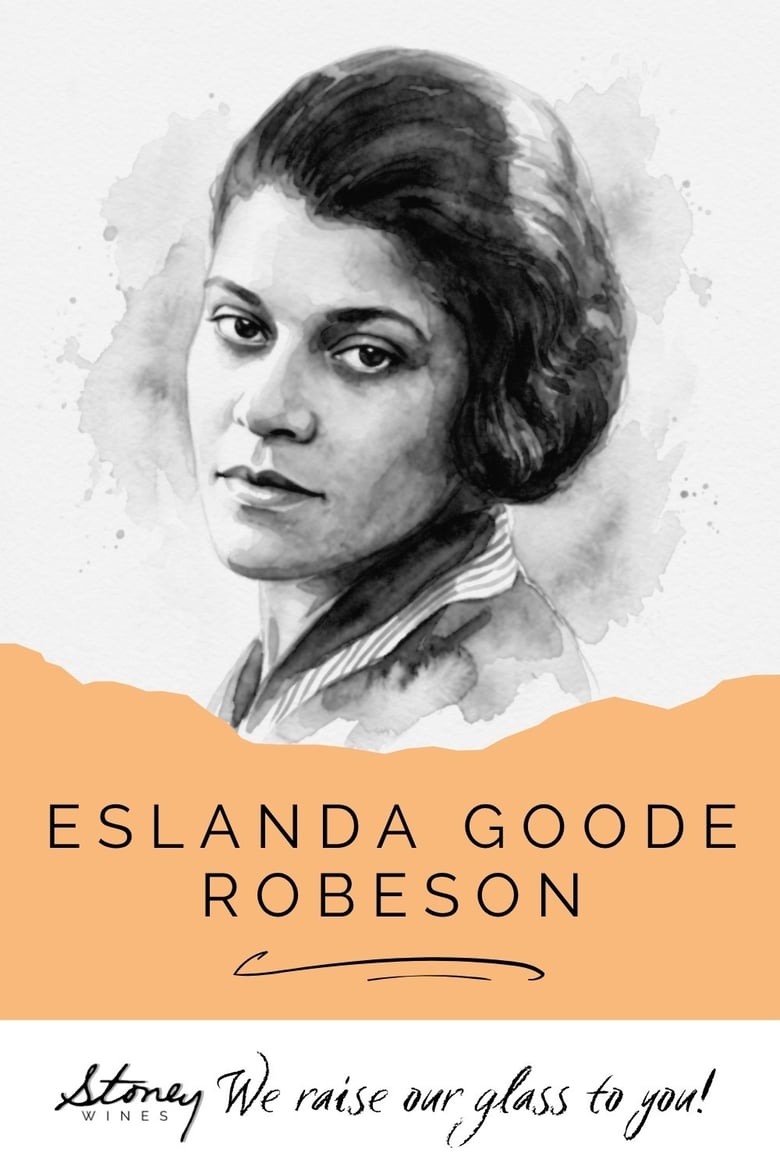
Eslanda Goode Robeson Fights for Freedom So We Raise Our Glass!
At Stoney Wines, we believe in celebrating individuals who have made the world a better, safer and more innovative place. This week, we raise our glass to Eslanda Goode Robeson, an anthropologist, author, filmmaker, and UN correspondent who spent her life fighting for African independence, global women's rights, and the dignity of oppressed people everywhere.
Born in 1895 in Washington, D.C., Eslanda was brilliant from the start. She studied chemistry at Columbia University, becoming one of the first Black women to work as a surgical pathologist at Columbia Presbyterian Hospital. But science was just the beginning.
Eslanda's intellectual curiosity led her to anthropology. She traveled to Africa multiple times in the 1930s and 1940s, studying cultures, documenting lives, and building relationships with leaders of independence movements across the continent. Her 1945 book African Journey challenged Western narratives about Africa, presenting the continent through her own eyes—as a place of rich cultures, complex societies, and people fighting for self-determination.
While the world might remember her as Paul Robeson's wife, Eslanda was nobody's shadow. She was a force—a thinker, a writer, an organizer who carved her own path in every space she entered.
As a United Nations correspondent in the 1950s, Eslanda reported on debates about colonialism, human rights, and the future of newly independent African nations. She used her platform to amplify the voices of anti-colonial leaders and to challenge the United States and European powers to end their exploitation of Africa and Asia.
She was a fierce advocate for the Pan-African movement, building coalitions between Black Americans and Africans fighting for liberation. She understood that freedom struggles were connected—that racism in Mississippi and colonialism in Kenya were two sides of the same system of oppression.
Eslanda also championed global women's rights, speaking at international conferences and pushing for women's inclusion in political movements. She refused to accept that liberation movements could ignore half the population. She demanded that women be at the table, making decisions, shaping the future.
But her activism came at a cost. During the McCarthy era, Eslanda was investigated, harassed, and had her passport revoked by the U.S. government. She was called before the House Un-American Activities Committee and accused of being a communist simply because she believed in racial justice, decolonization, and international human rights.
They tried to silence her. They tried to make her afraid. She kept speaking.
Eslanda testified before Congress with grace and defiance. She traveled when she could, wrote when she couldn't travel, and never stopped organizing. She understood that the work was bigger than her comfort, her safety, or her reputation.
She was a scholar who used her research to dismantle racist narratives. She was a journalist who told stories the mainstream media refused to cover. She was an activist who showed up consistently—at the UN, at conferences, in communities—building the networks that would support liberation movements for decades to come.
Eslanda proved that Black women anthropologists and intellectuals could shape global conversations. That activism wasn't just about protests—it was about scholarship, documentation, relationship-building, and showing up in rooms where decisions were made.
She didn't wait for permission. She didn't shrink herself. She walked into the United Nations, into anthropology, into international politics, and demanded to be heard.
So as we pour a glass of Stoney Wines this month, we honor Eslanda Goode Robeson for her intellect, her courage, and her lifelong commitment to freedom for all people.
🥂 Here's to Eslanda—a scholar, an activist, and a woman who understood that liberation is global. Cheers to her legacy and the movements she helped build.
Know someone fighting for justice on a global scale? Drop their name in the comments—we'd love to raise our glass to them too.