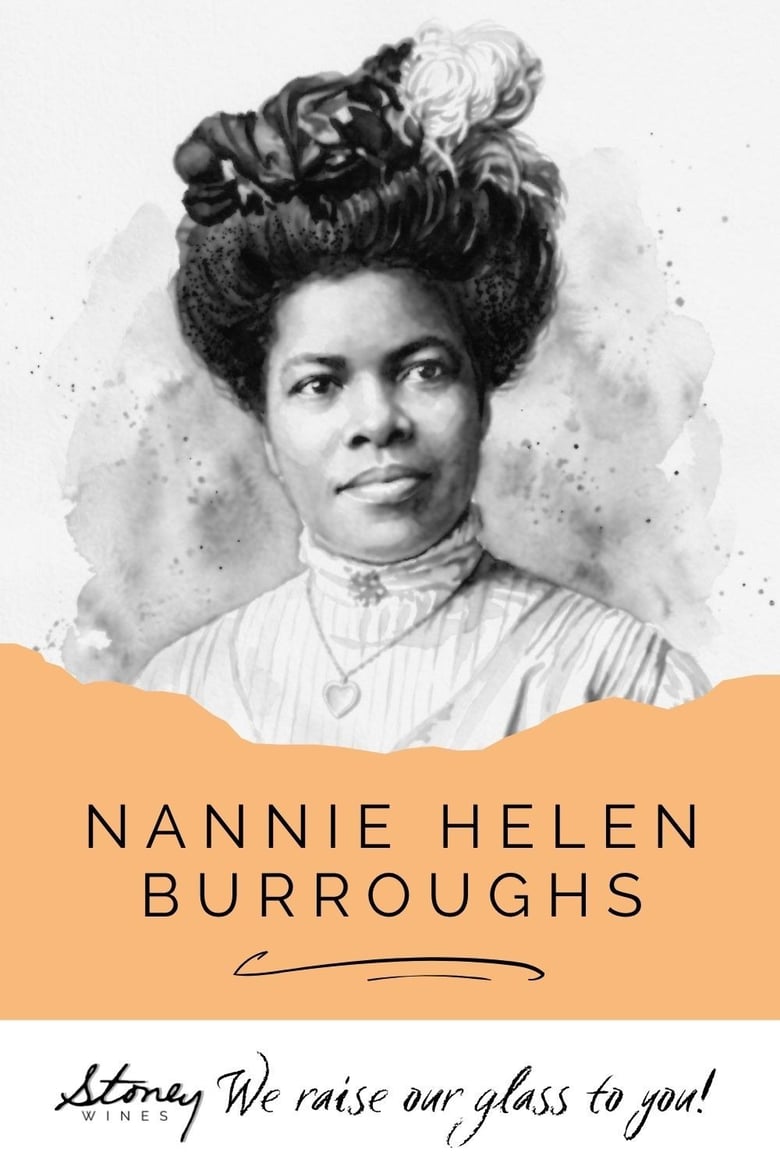
Nannie Helen Burroughs Builds Her Own School So We Raise Our Glass!
At Stoney Wines, we believe in celebrating individuals who have made the world a better, safer & more innovative place. This week, we raise our glass to Nannie Helen Burroughs, an educator, orator, and civil rights leader who understood that knowledge was power—and spent her entire life making sure Black women had access to both.
Born in 1879 in Orange, Virginia, Nannie grew up in Washington, D.C., in the shadow of a government that refused to recognize her humanity. She graduated at the top of her high school class, applied for a teaching position with the D.C. public schools, and was rejected—not because of her qualifications, but because of the color of her skin.
She could have let that door stay closed. Instead, she built her own.
In 1909, Nannie founded the National Training School for Women and Girls in Washington, D.C.—a landmark institution that gave Black women something the Jim Crow South was determined to deny them: practical skills, academic knowledge, and the tools to build independent, dignified lives.
At a time when Black women's economic empowerment wasn't just overlooked—it was actively suppressed—Nannie created a curriculum that was radically ahead of its time. Her students learned bookkeeping, printing, shoe repair, cooking, sewing, and domestic science alongside academic subjects and spiritual development. She wasn't just teaching skills—she was building economic independence, one student at a time.
The school operated on a simple but revolutionary philosophy Nannie called the "three Bs": the Bible, the bath, and the broom—cleanliness of spirit, body, and environment. But don't let the simplicity fool you. What Nannie was really teaching was self-respect, self-reliance, and the radical idea that Black women deserved to take up space in the American economy on their own terms.
In a Jim Crow era that offered Black women two choices—domestic servitude or poverty—Nannie's vocational training created a third option: skilled, educated, economically independent women who could support themselves and their communities.
The school drew students from across the country and even internationally. Hundreds of Black women passed through its doors, emerging with marketable skills and unshakeable confidence. They became teachers, business owners, community leaders, and mothers who passed on everything they'd learned to the next generation.
But Nannie's impact extended far beyond the classroom.
She was a thunderous orator whose speeches on racial justice, women's rights, and economic equality commanded audiences across the country. As a civil rights activist, she worked alongside Booker T. Washington and W.E.B. Du Bois—holding her own in every room she entered and refusing to let anyone silence her voice. She was a fierce advocate for women's suffrage within the Black community, challenging Black women to claim their political power at a time when most suffrage movements actively excluded them.
She wrote. She organized. She spoke truth to power with a boldness that made her one of the most influential voices of her era. She pushed back against racism, sexism, and economic exploitation—often simultaneously—never allowing the weight of any one battle to pull her from the others.
Her legacy didn't end with her death in 1961. The campus where she built her dream still stands today as a National Historic Landmark in Washington, D.C., preserving original structures like the Trades Hall and the Lincoln Memorial Arch. Though the original institution no longer operates in its founding form, the grounds continue their educational mission through The Monroe School, which prepares young people — including those facing homelessness and mental health challenges — for college and careers. Her vision lives on in the walls, the history, and the community still being served on that same corner.
Nannie proved that when the system refuses to include you, you build your own system. That Black women's education isn't just a social good—it's a revolutionary act. That vocational skills and academic excellence aren't in opposition—they're partners in the pursuit of liberation.
She didn't wait for women's liberation to catch up to her vision. She was decades ahead of it—quietly, powerfully, and permanently transforming the lives of Black women long before the rest of the world was ready to pay attention.
So as we pour a glass of Stoney Wines this month, we honor Nannie Helen Burroughs for her vision, her tenacity, and her lifelong commitment to making sure Black women had everything they needed to thrive.
🥂 Here's to Nannie—an educator, an activist, and a woman who built something that has lasted more than a century. Cheers to her living legacy and the generations of Black women she empowered.
Know someone building opportunities for others in their community? Drop their name in the comments—we'd love to raise our glass to them too.