
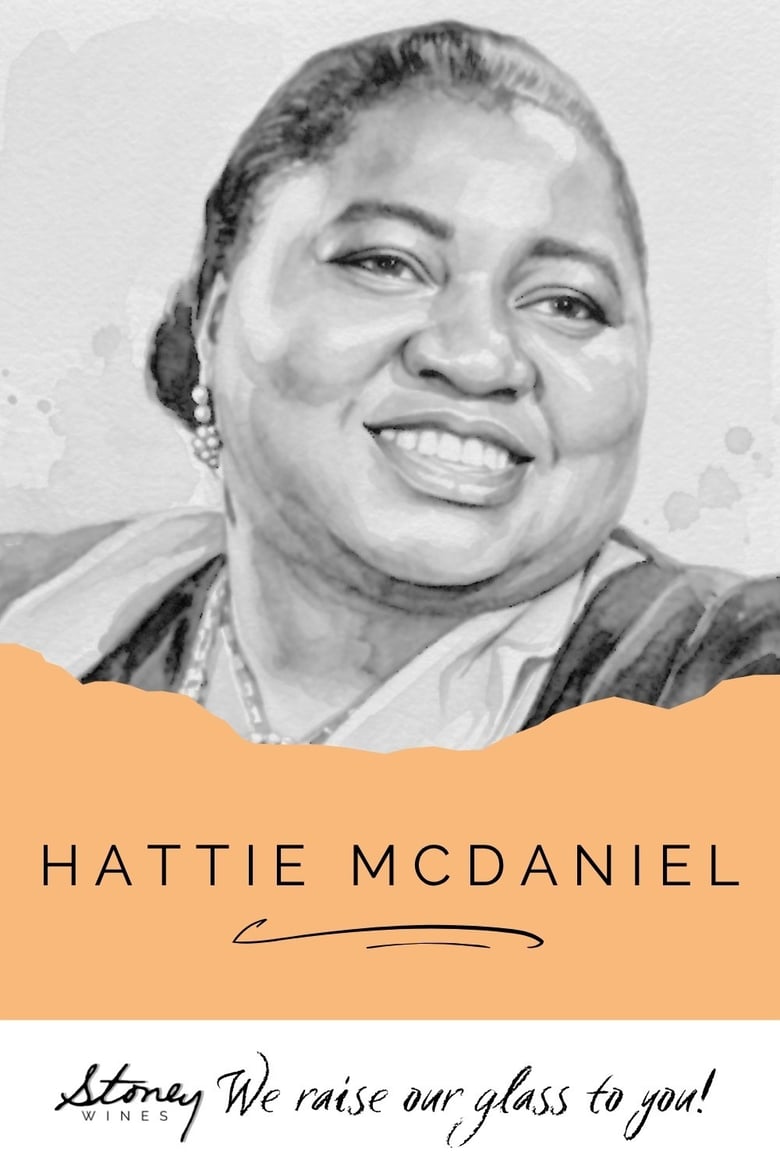
Hattie McDaniel Makes History So We Raise Our Glass!
At Stoney Wines, we believe in celebrating individuals who have made the world a better, safer & more innovative place. This week, we raise our glass to Hattie McDaniel—the first Black woman to win an Oscar, a trailblazer whose complicated, courageous legacy deserves to be understood in full.
Born in Wichita, Kansas, in 1893 to formerly enslaved parents, Hattie came into a world that had very specific ideas about what Black women were allowed to be. She became one of the first Black women to sing on American radio—a fact that rarely makes the history books—and appeared in more than 300 films during her career, becoming one of the most recognized Black performers in Hollywood.
On February 29, 1940, at the 12th Academy Awards, Hattie won Best Supporting Actress for her role as Mammy in "Gone with the Wind"—becoming the first African American to win an Oscar in any category. The moment was historic. It was also heartbreaking.
She was not allowed to attend the film's world premiere in Atlanta. At the ceremony itself—held at a whites-only hotel—she had to get special permission just to enter. She was whisked in through a side entrance and seated at a segregated table in the back, far from her fellow cast members. She walked to the stage to accept her award from that table. Hollywood celebrated her achievement while simultaneously enforcing the very racism her achievement was meant to transcend.
Hattie's win came at a cost—and she knew it.
The NAACP openly criticized her casting and the broader pattern of roles she accepted throughout her career—maids, servants, mammies. The criticism was pointed and specific: by repeatedly playing these characters, the argument went, she reinforced harmful stereotypes about Black women in a medium that reached millions of Americans.
Hattie pushed back. Her response became one of the most quoted lines in Black Hollywood history: "I'd rather play a maid than be one."
It was pragmatic. It was defiant. And it captured the impossible position Black performers occupied in Hollywood's racial discrimination era—navigating a system that would only open its doors a crack, deciding whether to walk through anyway or wait for a door that might never fully open.
Both positions—the NAACP's criticism and Hattie's defense—contain truth. She was working within a system she didn't build, making choices that paid her bills, funded her community philanthropy, and kept Black faces on screen at a time when invisibility was the alternative. She donated generously to the Black community throughout her life, quietly and consistently, even as she was celebrated by the white industry that seated her at the back of its own banquet.
Her complex Black Hollywood legacy resists easy conclusions. She was a barrier-breaker in a system that punished barrier-breakers. She was a working artist in an industry that offered Black women almost nothing to work with. She was a philanthropist, a pioneer, and a woman who accepted an Oscar at a segregated table and still said, with grace, "I sincerely hope I shall always be a credit to my race and to the motion picture industry."
She died in 1952. Her Oscar was donated to Howard University — and later went missing. The Academy sent a replacement decades later. Even in death, history couldn't quite hold onto her properly.
So as we pour a glass of Stoney Wines this month, we honor Hattie McDaniel — not as a simple hero or a simple cautionary tale, but as a fully human woman who navigated impossible circumstances with talent, pragmatism, and quiet dignity.
🥂 Here's to Hattie — the first Black woman Oscar winner, a radio pioneer, and a woman whose story is more complex, more painful, and more important than any single headline can hold. Cheers to her legacy and the full truth of her life.
Know someone whose contributions deserve to be understood more deeply? Drop their name in the comments — we'd love to raise our glass to them too.

Comments (0)
Join the conversation
Be the first to share your thoughts on this post
No comments yet
Start the discussion and be the first to comment