
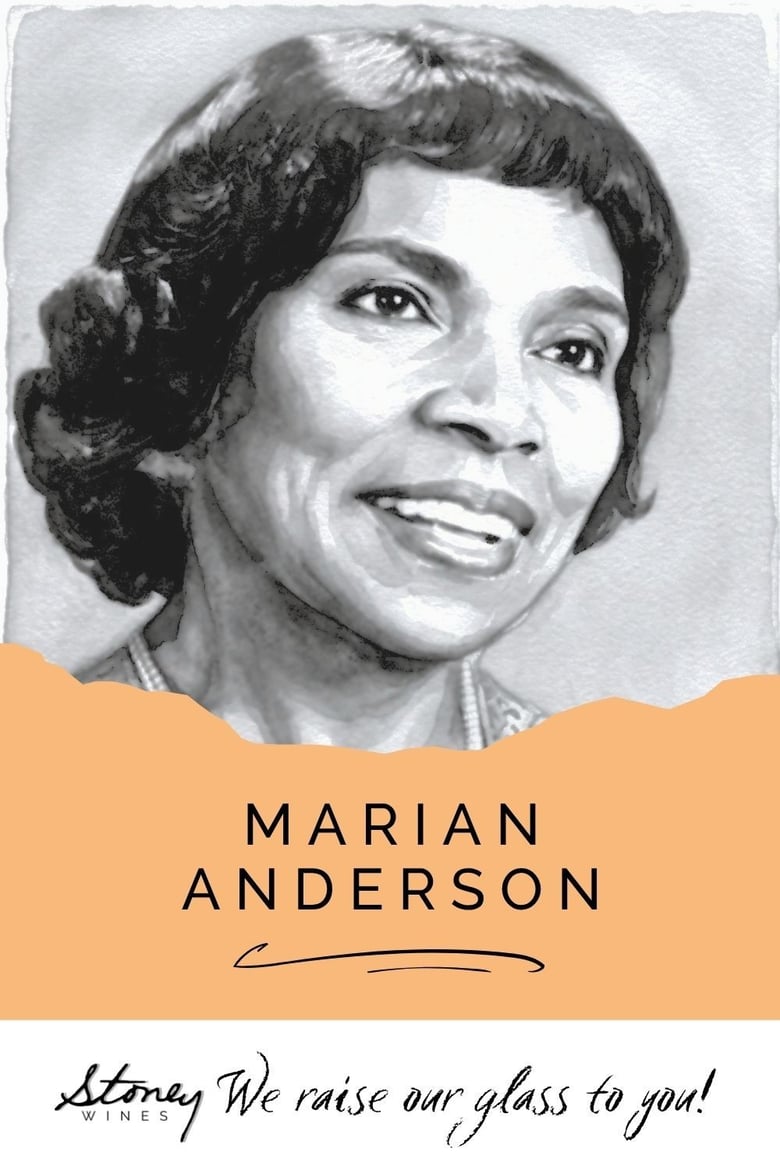
Marian Anderson Sings Freedom Into Existence So We Raise Our Glass!
At Stoney Wines, we believe in celebrating individuals who have made the world a better, safer & more innovative place. This week, we raise our glass to Marian Anderson—one of the greatest contralto voices in history, a Black opera singer who broke the color barrier in classical music and whose voice became a symbol of dignity, resistance, and hope for a nation still learning what equality meant.
On Easter Sunday, April 9, 1939, Marian Anderson stood on the steps of the Lincoln Memorial and sang to a crowd of 75,000 people. It was one of the most extraordinary moments in American history. And it happened because someone told her she couldn't.
Earlier that year, the Daughters of the American Revolution refused to allow Marian to perform at Constitution Hall in Washington, D.C.—their whites-only policy barring one of the most celebrated singers in the world from their stage simply because of her race. The city's Board of Education compounded the insult by refusing her use of a white public high school auditorium as an alternative.
The backlash was immediate. Eleanor Roosevelt resigned from the DAR in protest—a public, powerful act that turned Marian's exclusion into a national conversation. Interior Secretary Harold Ickes, working alongside the NAACP and Howard University, arranged something far grander: a free concert on the steps of the Lincoln Memorial, broadcast live on radio to millions of Americans across the country.
They tried to close a door. They ended up opening the entire sky.
Conductor Arturo Toscanini had called hers "a voice such as one hears once in a hundred years." On that Easter Sunday, 75,000 people—Black and white, in an era when such gatherings were rare and radical—heard it together. Secretary Ickes opened the concert with words that cut straight to the heart: "Genius draws no color line."
Marian was overwhelmed. At the concert's close she told the crowd: "I am so overwhelmed, I just can't talk. I can't tell you what you have done for me today. I thank you from the bottom of my heart."
But her journey to that moment had been long and complicated.
Born in 1897 in South Philadelphia to a working-class family, Marian showed extraordinary vocal gifts from childhood. When American institutions blocked her path—conservatories that wouldn't accept Black students, concert halls that wouldn't open their doors—she took her voice to Europe, where audiences in London, Paris, and Scandinavia celebrated her without reservation.
She was an international superstar abroad while facing segregation at home. The contrast was stark, painful, and telling. America's greatest Black classical music voice had to cross an ocean to be treated as the artist she was.
When she returned home, she returned transformed—not by bitterness, but by purpose. The Lincoln Memorial concert 1939 didn't just make her famous. It made her a symbol. A quarter century before Martin Luther King Jr. proclaimed his dream from those same steps, Marian Anderson was the first to raise a voice of hope from the Lincoln Memorial.
She kept going. In 1955, she became the first Black singer to perform at the Metropolitan Opera—another color barrier in classical music shattered, another door opened for the generations that followed. She sang the National Anthem at President Kennedy's inauguration in 1961. And in 1963, she stood on the steps of the Lincoln Memorial again—this time alongside Martin Luther King Jr. at the March on Washington, her voice and her presence a living bridge between the moment she had helped create and the movement that had grown from it.
Eleanor Roosevelt and Marian remained friends for the rest of Roosevelt's life. The concert they helped create together became what the FDR Presidential Library called "a watershed moment in civil rights history, bringing national attention to the country's color barrier as no other event had previously done."
Marian Anderson never set out to be a civil rights icon. She set out to sing. But in a country determined to silence her, every note she hit was an act of resistance. Every stage she took was a door she opened for someone else. Every audience she moved brought America a little closer to the ideals it claimed to believe in.
She died in 1993 at the age of 96—having lived long enough to see the world she helped change, having given her voice to a country that first tried to refuse it.
So as we pour a glass of Stoney Wines this month, we honor Marian Anderson for the voice that couldn't be silenced, the dignity that couldn't be diminished, and the courage to sing freedom into existence when the doors were closed.
🥂 Here's to Marian—a contralto, a pioneer, and a woman whose voice was heard once in a hundred years and whose legacy will last forever. Cheers to her extraordinary life and the music that moved a nation.
Know someone whose art has become an act of resistance? Drop their name in the comments—we'd love to raise our glass to them too.

Comments (0)
Join the conversation
Be the first to share your thoughts on this post
No comments yet
Start the discussion and be the first to comment